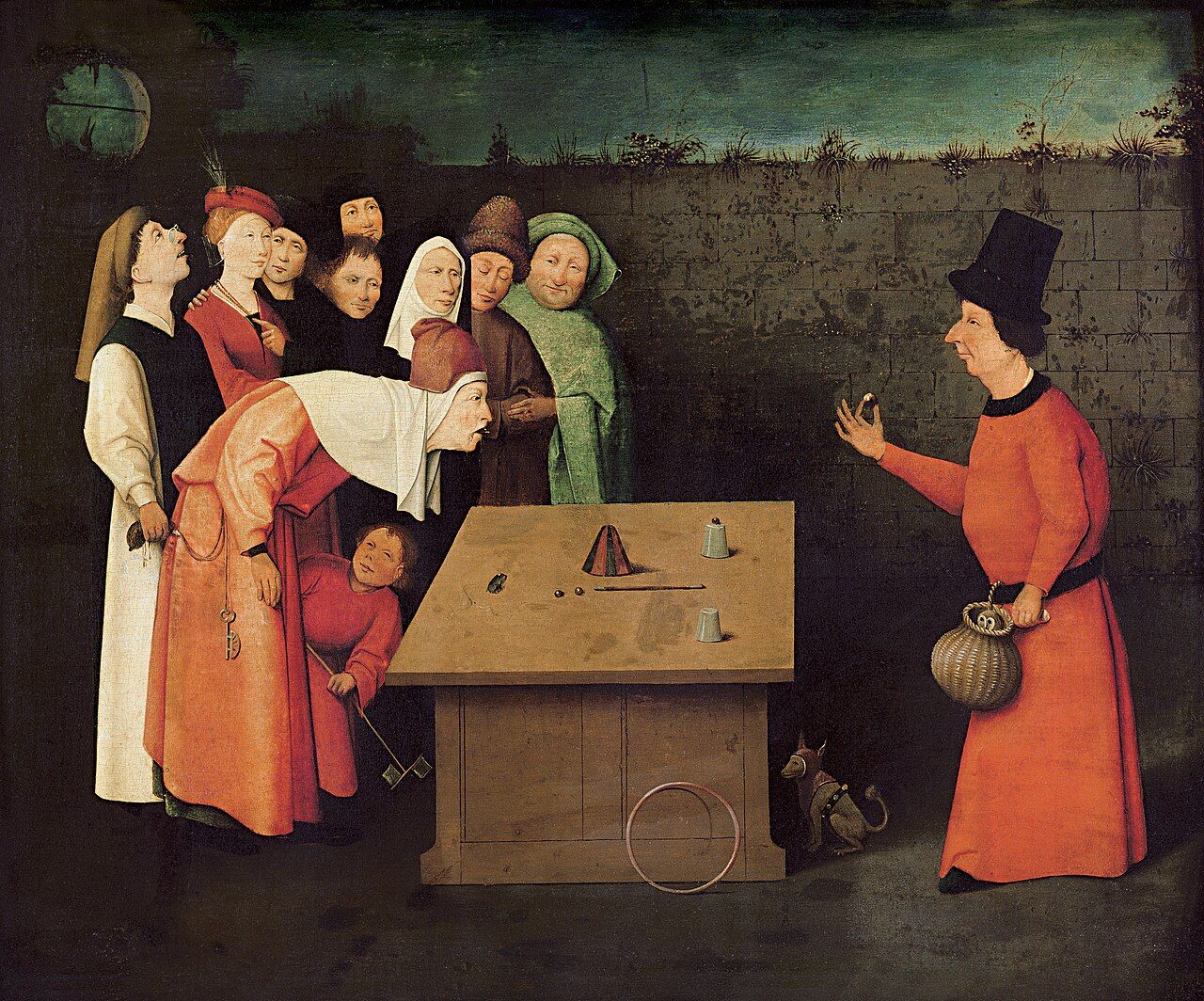
A conjurer at a table performs the cups and balls to a rapt crowd, while a man behind the gaping spectator lifts his purse
Hieronymus Bosch and workshop, The Conjurer, c. 1502. Musée Municipal, Saint-Germain-en-Laye. Every eye is on the pearl in the conjurer's fingers. Nobody watches the man at the back, who is stealing a purse.Public domain, via Wikimedia Commons.

An illustrated guide

Is consciousness a magic trick?

You seem to have an inner world: a private show of colours, sounds and feelings that no brain scan could ever capture. Daniel Dennett argued that this is how the brain's work seems from the inside, not how it is. The task is to explain the trick, not to be dazzled by it.

This site starts from Dennett, and from one short essay in particular, "Illusionism as the Obvious Default Theory of Consciousness" (2016). In it he compares the philosophy of mind with stage magic. We know a conjurer has not really sawn a woman in half, even when we cannot see how it was done. Dennett says we should treat the apparent magic of experience the same way.

From there, each major view of the mind gets its own page: what it claims, what drives it, and where it parts company with Dennett. His closest allies come first, then a long history running from Aristotle's soul to Ned Block's nation of China, and finally the thinkers who reject his picture outright. Each page has an interactive figure of its own, from Leibniz's mill to Mary's black-and-white room.
Dennett's view Stage magic, the Cartesian Theatre, multiple drafts and the red stripe that isn't anywhere, in six interactive figures. Watch: The magician's secret A four-and-a-half-minute narrated film of Dennett's argument, told through animations and paintings. Watch: The ghost in the machine Descartes builds the inner theatre; Ryle, Dennett's teacher, calls it a category mistake. Under five minutes. Watch: Inside the mill Leibniz walks inside a thinking machine and Huxley hears its steam whistle. Under five minutes. The allies Keith Frankish's illusionism, Nicholas Humphrey's magical mystery show, Michael Graziano's attention schema and the Churchlands. The long history From Aristotle, Descartes, Leibniz and Hume to Ryle, Turing, Putnam, Nagel, Searle, Jackson and Block. The far side Anil Seth's controlled hallucinations, David Chalmers's zombies and Philip Goff's conscious universe. The lab Every experiment on the site in one place: colour phi, after-images, blindsight, change blindness, the blind spot and more. Compare all views Every thinker in one table: is the mind a function, are qualia real, and where each meets and parts from Dennett. Videos A narrated series in the style of the Philosophy of Time films, one episode for each turn in the argument. Reading Books and audiobooks to explore next, with links for UK and US readers. Sister site: Philosophy of Time Does time flow? David Deutsch set against the Greeks and today's physicists, with ten narrated films.