About
About this site
An independent study site on the philosophy of mind, built around one short essay by Daniel Dennett and the long argument it joins. A sister to Philosophy of Time.
What it is
The starting point is Dennett's "Illusionism as the Obvious Default Theory of Consciousness" (2016), his reply to Keith Frankish. In a few pages it sets out the strategy behind his whole view of the mind: treat consciousness like stage magic, and explain the trick before believing in real magic. The Dennett page follows that essay and the wider theory behind it. Each major view of the mind then gets a page of its own, setting out the view, the argument for it, and where it meets and parts from Dennett, from his closest allies through two and a half thousand years of history to the thinkers who reject his picture outright.
Who made it

I'm Tim Stephenson. I made Philosophy of Time to work through David Deutsch's chapter on time, and this site to do the same for the mind. I am drawn to functionalist views, and the site starts from Dennett for that reason, but every view here is set out as strongly as I can manage. If you think I have got Dennett, or anyone else, wrong, I would like to know.
Sources and copyright
- Dennett's essay and the works of other modern authors are in copyright. The site summarises them in its own words and quotes at most one short passage from any copyrighted source on a page.
- Where a modern author is set off in a quotation box, the words are our paraphrase, marked "after".
- Quotations from Descartes, Leibniz, Aristotle and Galileo are our own translations. Hume, Huxley, William James and Turing are quoted from works now in the public domain.
- Book links on the reading page are plain links, not affiliate links.
Images
The images are public-domain artworks and photographs from Wikimedia Commons, resized to 1280 pixels wide. The full list, with a link to each file's Commons page, is below and in art/CREDITS.md.
| Work | Collection | Source | Used on |
|---|---|---|---|
| Hieronymus Bosch and workshop, The Conjurer, c. 1502 | Musée Municipal, Saint-Germain-en-Laye | Commons | Home, Videos |
| Georges de La Tour, The Cheat with the Ace of Diamonds, c. 1636–38 | Musée du Louvre | Commons | Dennett |
| After William Hogarth, Satire on False Perspective, 1754 | Commons | Dennett | |
| Jan Saenredam after Cornelis van Haarlem, Plato's Cave, 1604 | Commons | Dennett | |
| Robert Fludd, the eye of the imagination, 1617–19 | Commons | Dennett, Glossary | |
| Hans Holbein the Younger, The Ambassadors, 1533 | National Gallery, London | Commons | Frankish |
| The Müller-Lyer figure, after Franz Brentano, 1892 | Commons | Frankish | |
| Claude Monet, Impression, Sunrise, 1872 | Musée Marmottan Monet | Commons | Humphrey |
| Georges de La Tour, Magdalene with the Night Light, c. 1640–45 | Musée du Louvre | Commons | Graziano |
| Santiago Ramón y Cajal, drawings of the cerebral cortex, c. 1899 | Commons | The Churchlands | |
| Portrait of Aristotle, Roman copy after Lysippos | Palazzo Altemps, Rome; photo Jastrow, public domain | Commons | Aristotle |
| After Frans Hals, Portrait of René Descartes | Musée du Louvre | Commons | Descartes |
| Illustration from Descartes' Treatise of Man, 1664 | Commons | Descartes, Videos | |
| Jacob van Ruisdael, The Windmill at Wijk bij Duurstede, c. 1670 | Rijksmuseum, Amsterdam | Commons | Leibniz, Videos |
| Allan Ramsay, David Hume, 1766 | Scottish National Portrait Gallery | Commons | Hume, Seth (two-tone figure) |
| Claude Monet, The Saint-Lazare Station, 1877 | Musée d'Orsay | Commons | Huxley |
| Carlo Pellegrini ("Ape"), Thomas Henry Huxley, Vanity Fair, 1871 | Commons | Huxley | |
| J. M. W. Turner, High Street, Oxford, 1810 | Ashmolean Museum, Oxford | Commons | Ryle |
| Joseph Friedrich zu Racknitz, the Mechanical Turk, 1789 | Commons | Turing, Videos | |
| William N. Jennings, photograph of lightning, 1882 | Commons | Place and Smart | |
| Giuseppe Arcimboldo, Vertumnus, 1591 | Skokloster Castle | Commons | Putnam, Videos |
| Ernst Haeckel, Chiroptera, Art Forms in Nature, 1904 | Commons | Nagel, Videos | |
| Francisco Goya, The Sleep of Reason Produces Monsters, 1799 | Commons | Nagel | |
| Antonello da Messina, Saint Jerome in his Study, c. 1475 | National Gallery, London | Commons | Searle, Reading |
| Johann Wolfgang von Goethe, colour wheel, 1809 | Freies Deutsches Hochstift, Frankfurt | Commons | Jackson |
| Pieter Bruegel the Elder, The Tower of Babel, 1563 | Kunsthistorisches Museum, Vienna | Commons | Block, Compare |
| Henry Fuseli, The Nightmare, 1781 | Detroit Institute of Arts | Commons | Seth |
| Dante Gabriel Rossetti, How They Met Themselves, c. 1860–64 | Fitzwilliam Museum, Cambridge | Commons | Chalmers, Videos |
| Justus Sustermans, Portrait of Galileo Galilei, 1636 | Uffizi Galleries, Florence | Commons | Goff |
| Odilon Redon, The Eye, Like a Strange Balloon, Moves Towards Infinity, 1882 | Art Institute of Chicago | Commons | Goff, Videos |
| Joseph Wright of Derby, An Experiment on a Bird in the Air Pump, 1768 | National Gallery, London | Commons | Lab |
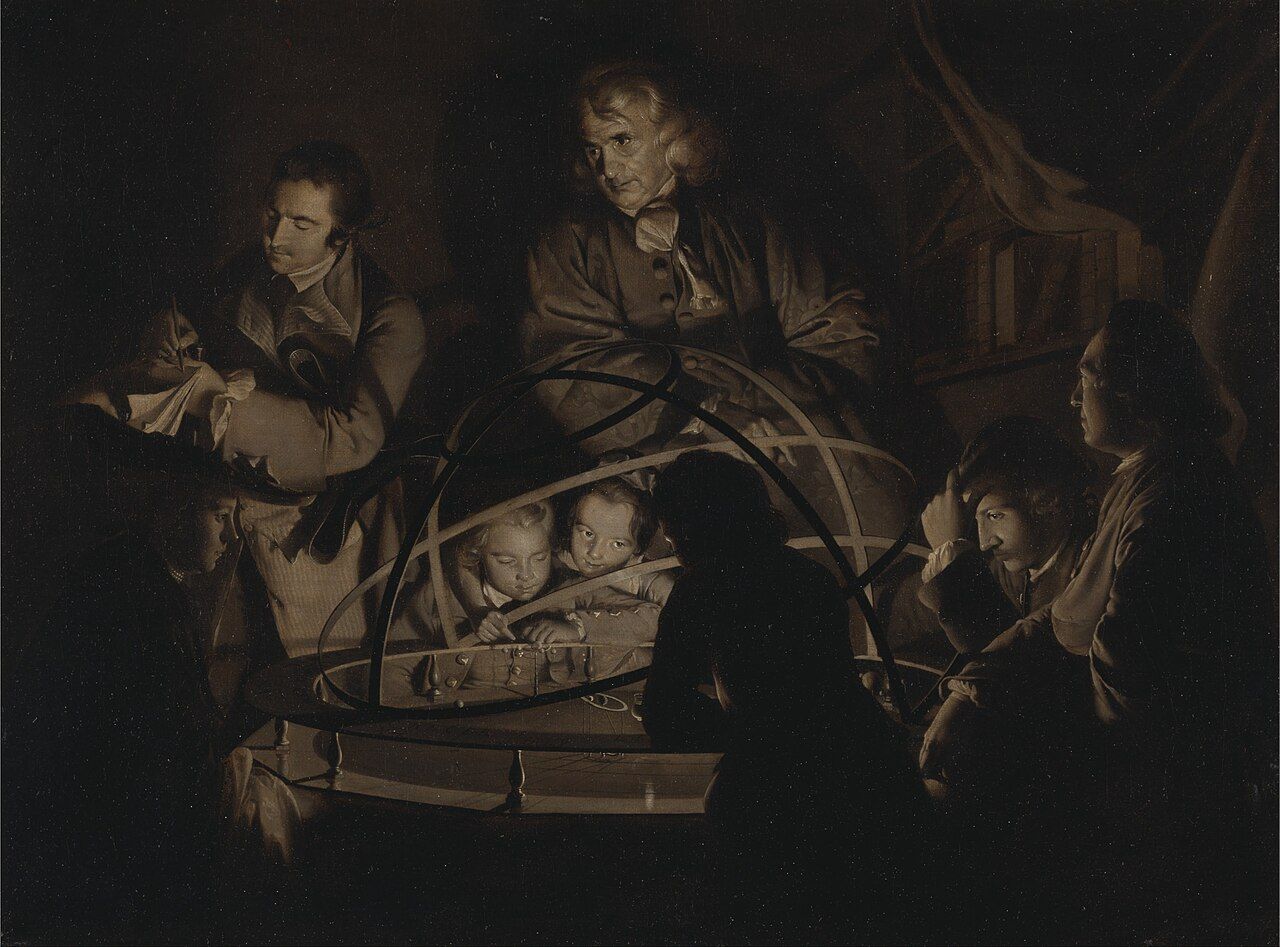
| Joseph Wright of Derby, A Philosopher Lecturing on the Orrery, c. 1766 | Derby Museum and Art Gallery | Commons | About |
| Willem Swanenburg after Jan Cornelis Woudanus, The University Library at Leiden, 1610 | Commons | Popper | |
| Julia Margaret Cameron, Charles Darwin, 1868 | Commons | Popper | |
| The Flammarion engraving, from Camille Flammarion's L'atmosphère, 1888 | Commons | Deutsch | |
| Portrait of Joseph Marie Jacquard, woven in silk, 1839 | Commons | Deutsch | |
| Elias Gottlob Haussmann, Johann Sebastian Bach, 1748 | Commons | Hofstadter | |
| Ouroboros, Greek alchemical manuscript copied by Theodoros Pelecanos, 1478 | Commons | Hofstadter | |
| Henri Rousseau, The Dream, 1910 | Museum of Modern Art, New York | Commons | Joscha Bach |
| Attributed to Caravaggio, Narcissus, c. 1597–99 | Galleria Nazionale d'Arte Antica, Rome | Commons | Joscha Bach |


Figures and videos
The interactive figures are hand-written SVG and JavaScript, with no tracking and no outside libraries, and they respect your device's reduced-motion setting. The videos are narrated with an AI voice, as on the Philosophy of Time films.