La Haye, Touraine 1596 – Stockholm 1650
René Descartes
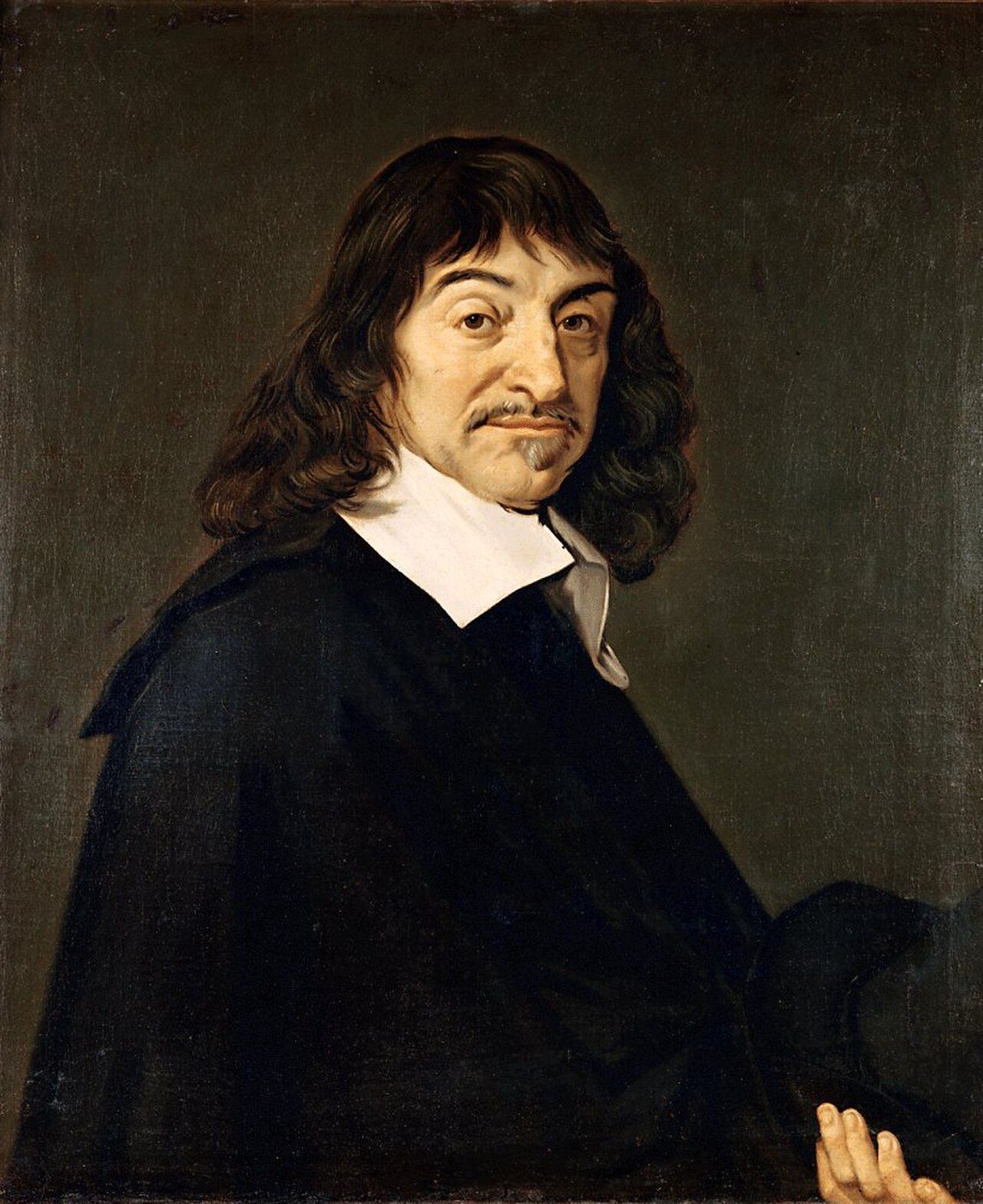
The body is a machine, as mechanical as a clock or a fountain. The mind is something else entirely: a thinking thing with no size, shape or position. The two meet at one small point deep in the brain.
The view
Descartes set out to find something he could not doubt. The senses deceive; dreams feel real; perhaps an evil demon is feeding him a false world. But while he doubts, he must exist to do the doubting: "I think, therefore I am", as he put it in the Discourse on Method (1637). In the Meditations (1641) he asks what this "I" is. Our translation:
A thing that thinks: that is, a thing that doubts, understands, affirms, denies, wills, refuses, and also imagines and senses. Descartes, Meditations II (1641)
He can doubt that he has a body, but he cannot doubt that he thinks. So, he argues, the mind and the body are distinct things: mind is "thinking substance", body is "extended substance", stuff that takes up space. This is substance dualism, and for three centuries it defined the problem of the mind.
The argument
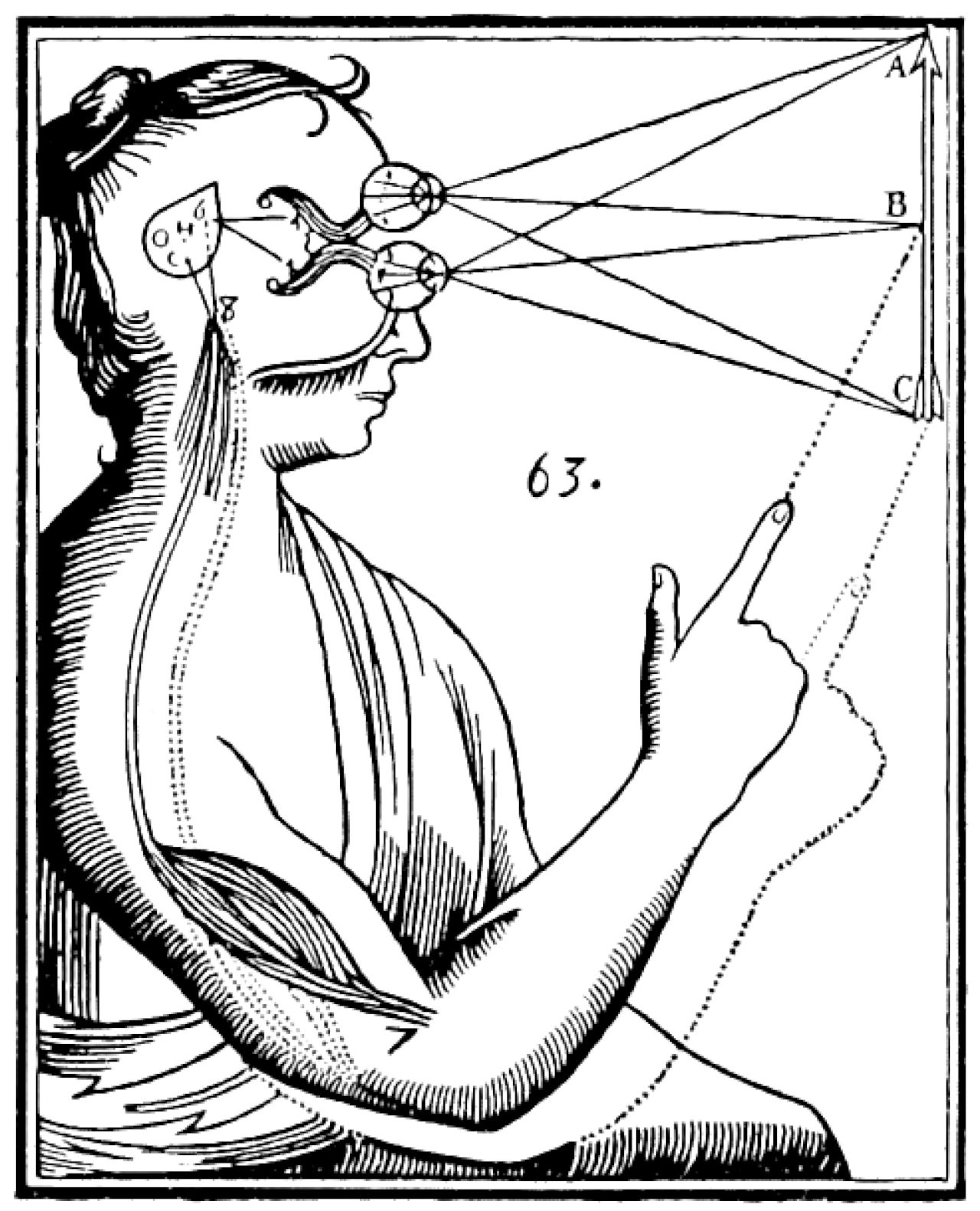
Descartes was also a pioneering physiologist, and much more of a mechanist than his dualism suggests. In his Treatise of Man, published after his death, he described the body as a machine driven by "animal spirits", a fine fluid pumped through hollow nerves like water through the pipes of the mechanical grottoes in royal gardens, where hidden valves made statues move as visitors stepped on them. Many actions need no mind at all. Put your foot near a fire and the heat tugs a thread in the nerve, which opens a valve in the brain, which sends spirits down to pull the foot away. Run the figure below.
What machines could not do, Descartes thought, was use language flexibly or reason about anything whatever. For that you need a mind. And the mind, though it has no location, acts on the body at one place: the pineal gland, a small structure he believed hung in the middle of the brain, where the images from the two eyes could be united into one. In The Passions of the Soul (1649) he describes the soul nudging the gland to steer the flow of spirits, and the spirits moving the gland to present images to the soul.
The obvious difficulty was put to Descartes in 1643 by Princess Elisabeth of Bohemia. How can a thinking thing with no extension push anything? Pushing needs contact, and contact needs a surface. Descartes' replies never satisfied her, and the "interaction problem" has never been solved.
Where he meets Dennett
On the body, a long way. Descartes' mechanical physiology, in which much of what animals and people do is done by a machine with no understanding, anticipates the modern brain science Dennett relied on. Seen from Dennett's side, Descartes got the body right and the mind wrong.
Where they part
Everywhere else. Dennett's whole theory is built against Descartes' picture of a single place where everything comes together to be witnessed by the self. Even materialists who reject the soul, he argued, keep the pineal gland in another form, and his name for that leftover, the Cartesian Theatre, is a reproach to Descartes. Descartes also took the mind to be transparent to itself: whatever else you doubt, you cannot be wrong about your own thoughts. Dennett thought introspection was far less reliable than that, and that the conviction of being a single, indubitable thinking thing is one of the brain's most impressive effects.
And on machines they disagree directly. Descartes was sure no machine could hold a conversation. Dennett, following Turing, thought there was no reason in principle why one couldn't, and lived to see large language models make the question urgent.
| Descartes | Dennett | |
|---|---|---|
| What is the mind? | A thinking substance, distinct from the body. | What the brain does: a pattern of functions. |
| Is phenomenal consciousness real? | Yes: thought, including sensation, is the one thing we cannot doubt. | No, not as philosophers define it. It is an illusion produced by the brain. |
| Could a machine have a mind? | No. No machine could use language or reason flexibly. | Yes, in principle, if it does what we do. |
| Is there a hard problem? | An interaction problem: how two substances affect each other. | No. There is the Hard Question: and then what happens? |
Further reading
- René Descartes, Meditations on First Philosophy, trans. John Cottingham (Cambridge, 1996).
- Lisa Shapiro (ed. and trans.), The Correspondence between Princess Elisabeth of Bohemia and René Descartes (Chicago, 2007).
- Antonio Damasio, Descartes' Error (Putnam, 1994): a neuroscientist's case against separating reason from the body.
- Descartes and the pineal gland, Stanford Encyclopedia of Philosophy.