Stagira and Athens, 384–322 BC
Aristotle
The soul is not a ghost lodged in the body. It is what the body does: the organisation that makes a living thing able to feed, perceive and think. Ask whether soul and body are one and you have asked a muddled question.
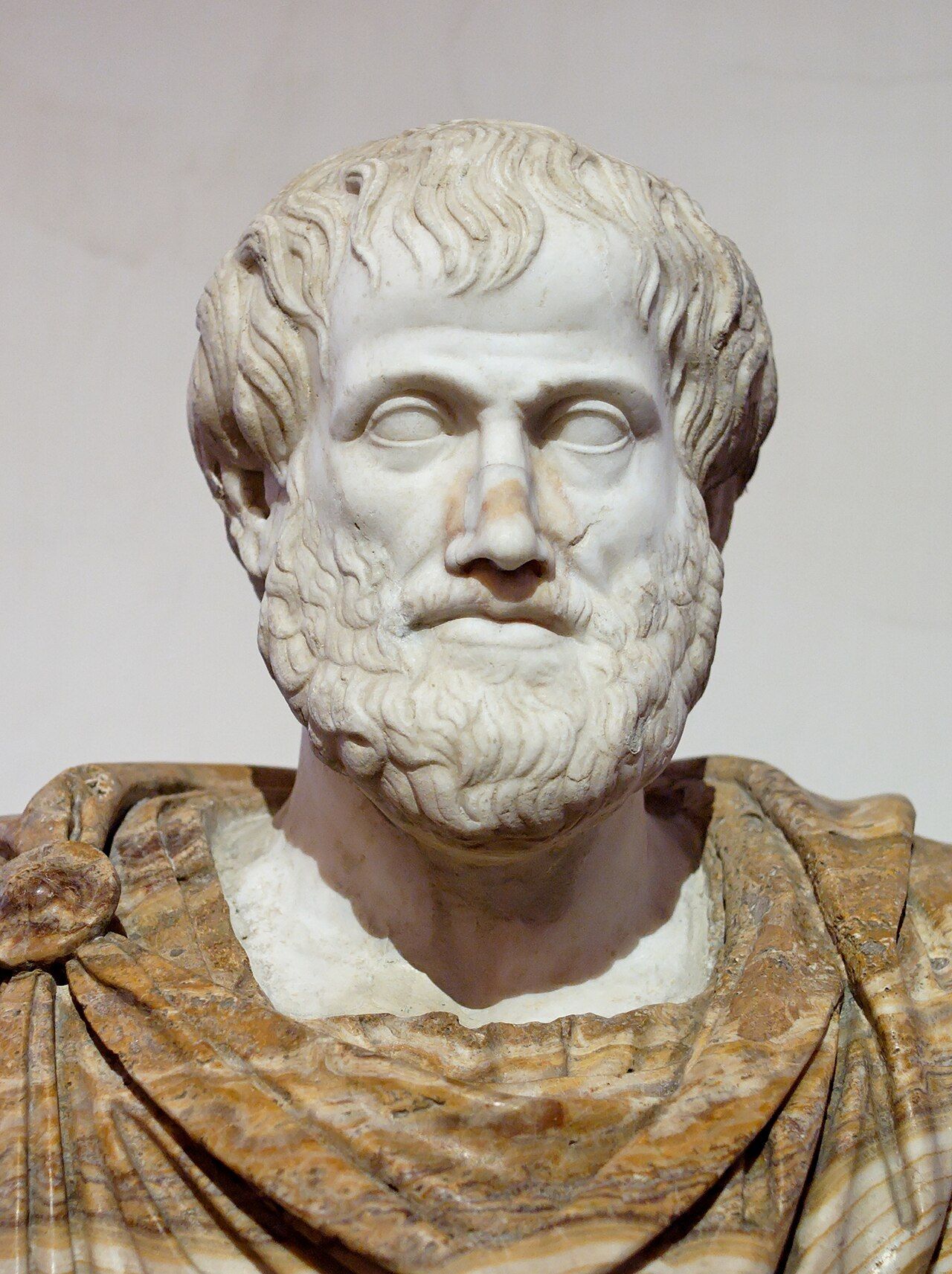
The view
For Aristotle, everything in nature is a combination of matter, what a thing is made of, and form, how that matter is organised and what it can do. A bronze statue is bronze in a certain shape; a house is bricks and timber arranged to shelter people. The form is not an extra ingredient sitting alongside the matter. It is the matter's organisation.
In On the Soul (De Anima) he applies the same idea to living things. The Greek word psychē, usually translated "soul", meant whatever makes something alive. Aristotle defines it as the form of a natural body that has life: the set of capacities, from nutrition and growth through perception and movement to thought, that a living body exercises. Plants have the nutritive soul; animals add perception and desire; humans add reason. Each level depends on the ones below.
The argument
Aristotle makes the point with two famous analogies. The translations here are our own.
If the eye were an animal, sight would be its soul. Aristotle, On the Soul II.1, 412b
An eye that cannot see, he goes on, is an eye only in name, like an eye carved in stone or painted in a picture. In the same way, if an axe were a living thing, cutting would be its soul. Take away the capacity and what remains is not a dead axe but a lump of iron in an axe's shape. The figure lets you test the idea.
Change the material and the axe is still an axe, because it can still cut. Melt it and every atom of iron is still there, but the axe is gone. The soul, on this view, is neither a substance of its own nor simply the stuff of the body. It is what the stuff is organised to do. From this Aristotle draws his second analogy: there is no more need to ask whether soul and body are one than to ask whether the wax and the shape stamped on it by a seal are one.
He was less sure about one capacity, the intellect, which he thought might work without a bodily organ. A notoriously difficult passage in book III suggests that some part of the mind may be separable and even immortal. Readers have argued about what he meant ever since.
Where he meets Dennett
Aristotle's view has often been called the first functionalism. Hilary Putnam and Martha Nussbaum discussed the comparison at length, and it is a good one. Like the functionalists, Aristotle defines a mind by what it can do rather than what it is made of, and treats the same capacity as possible in different materials, within limits. Dennett's insistence that a mind is a pattern of competences, not a special substance, belongs to this family. So does his view that the question "where is the mind?" is as confused as "where is the cutting?".
Where they part
Aristotle's forms come with built-in purposes. An eye is for seeing; a soul is the goal a body's development aims at. Dennett also talks freely of what things are for, but for him such purposes are products of natural selection, "free-floating rationales" that no one designed, not features of nature's basic structure. Aristotle also thought matter mattered more than modern functionalists do: a saw, he says, has to be made of iron if it is to saw, and a soul needs a body of the right kind.
And Aristotle had no Hard Problem, because he had no notion of consciousness as a private inner show. Perceiving, for him, was the eye taking on the form of what it sees, a public, biological event. That absence is one reason some modern illusionists find him congenial. The idea of an inner theatre came later.
| Aristotle | Dennett | |
|---|---|---|
| What is the mind? | The form of a living body: its capacities to feed, perceive and think. | What the brain does: a pattern of functions. |
| Is phenomenal consciousness real? | The question does not arise: perception is a bodily activity, not an inner show. | No, not as philosophers define it. It is an illusion produced by the brain. |
| Could a machine have a mind? | Only a living body has a soul, though some matter could serve in place of other. | Yes, in principle, if it does what we do. |
| Is there a hard problem? | No. Asking if soul and body are one is like asking about wax and its stamp. | No. There is the Hard Question: and then what happens? |
Further reading
- Aristotle, De Anima (On the Soul), trans. Hugh Lawson-Tancred (Penguin, 1986).
- Martha C. Nussbaum and Amélie Oksenberg Rorty (eds), Essays on Aristotle's De Anima (Oxford, 1992), including Nussbaum and Putnam's "Changing Aristotle's Mind".
- Christopher Shields, Aristotle, 2nd edn (Routledge, 2014).
- Aristotle's psychology, Stanford Encyclopedia of Philosophy.