Edinburgh, 1711–1776
David Hume
Look inside for your self and you will never find it: only a heat, a colour, a worry, a pleasure. The self is not a thing that has perceptions. It is a bundle of perceptions, held together by the way they follow one another.
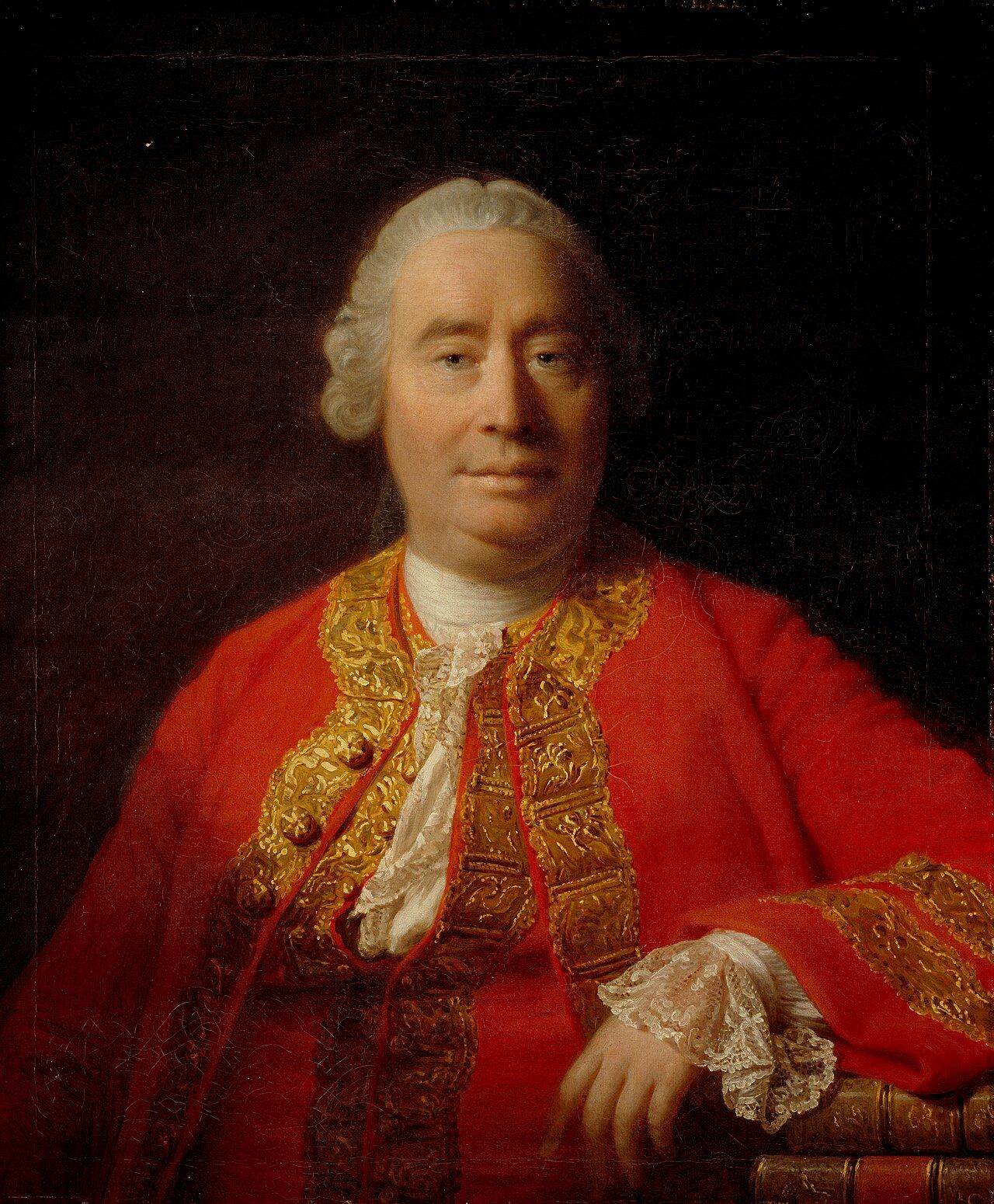
The view
Hume wrote A Treatise of Human Nature in his twenties, and published it in 1739–40. He later complained that it "fell dead-born from the press", yet it became one of the most influential works of philosophy in English. Its aim was a science of the mind on the model of Newton's science of nature: start from what can be observed, and explain everything else as built from it.
What can be observed in the mind, Hume says, are perceptions. They come in two kinds: vivid impressions, such as sensations and feelings, and fainter ideas, copies of impressions used in thought. Every idea must trace back to an impression. So when philosophers talk of a self, a soul or a simple, continuing thinking substance, Hume asks the obvious question: from what impression is that idea derived?
The argument
For my part, when I enter most intimately into what I call myself, I always stumble on some particular perception or other, of heat or cold, light or shade, love or hatred, pain or pleasure. Hume, A Treatise of Human Nature 1.4.6 (1739)
He never catches himself without a perception, and never observes anything but the perception. The self, then, is "nothing but a bundle or collection of different perceptions, which succeed each other with an inconceivable rapidity, and are in a perpetual flux and movement". Try the search yourself below.
In the same section Hume reaches for a famous image. The mind, he says, is a kind of theatre, where perceptions make their entrances, pass, re-pass and glide away. Then he immediately takes it back. The comparison must not mislead us, he warns: there are only the successive perceptions, and we have no notion at all of the place where the scenes are represented, or of what it is made of. The theatre has no stage.
Hume was not entirely happy with his own account. In an appendix he admitted that he could not explain what binds the perceptions into one bundle, and confessed the problem was too hard for his understanding.
Where he meets Dennett
Very closely. Dennett's name for the self, a centre of narrative gravity, is a direct descendant of the bundle. A centre of gravity is not a particle; it is an abstraction, a point defined by the distribution of mass, and yet it is perfectly real and useful. The self, Dennett argued, is the same kind of thing: the point around which a brain's stories about itself are organised. Press the second button and watch the centre follow the perceptions, belonging to none of them.
Hume's withdrawn theatre is also Dennett's in spirit. Hume used the picture and then warned it was misleading, because there is no place where the show is staged. Dennett's attack on the Cartesian Theatre makes the same point two and a half centuries later, with neuroscience to back it.
Where they part
Hume trusted introspection to report the perceptions themselves. He doubted the self, but he never doubted the impressions; they were his data. Dennett went one step further. The perceptions as introspection presents them, with their vivid inner qualities, are also a construction, and the reports need explaining like everything else. Where Hume's science of the mind starts from impressions, Dennett's starts from what people say about them.
| Hume | Dennett | |
|---|---|---|
| What is the mind? | A bundle of perceptions, linked by resemblance, contiguity and cause. | What the brain does: a pattern of functions. |
| Is phenomenal consciousness real? | Impressions are the basic data; the self is what is doubtful. | No, not as philosophers define it. It is an illusion produced by the brain. |
| Could a machine have a mind? | Not his question, though animals, he argued, reason much as we do. | Yes, in principle, if it does what we do. |
| Is there a hard problem? | What unites the bundle was, he admitted, too hard for him. | No. There is the Hard Question: and then what happens? |
Further reading
- David Hume, A Treatise of Human Nature, ed. David Fate Norton and Mary J. Norton (Oxford, 2000), Book 1, Part 4, Section 6, "Of personal identity".
- Julian Baggini, The Ego Trick (Granta, 2011): a modern bundle theory, written for general readers.
- Daniel C. Dennett, "The Self as a Center of Narrative Gravity" (1992), widely reprinted.
- David Hume, Stanford Encyclopedia of Philosophy.