Vienna 1889 – Cambridge 1951
Ludwig Wittgenstein
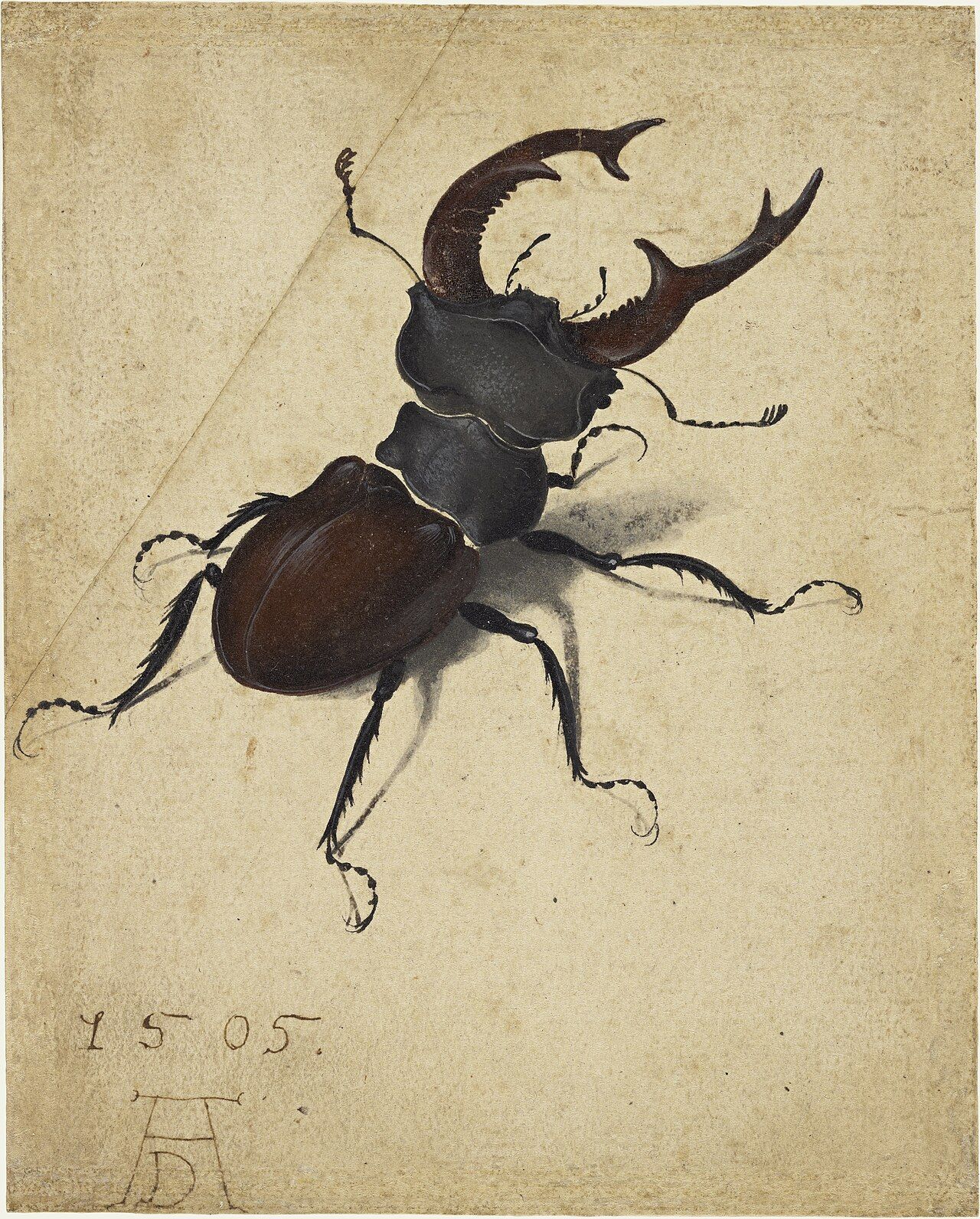
Suppose everyone had a box with something in it called a beetle, and nobody could look in anyone else's box. Then whatever is in the boxes, even nothing at all, could play no part in what the word means. Wittgenstein thought the same was true of the private inner objects that philosophers call sensations.
The view
Wittgenstein was born into one of the richest families in Vienna, trained as an engineer, and came to Cambridge in 1911 to study with Bertrand Russell. His first book, the Tractatus Logico-Philosophicus (1921), tried to show how language pictures the world. He then gave up philosophy for years, worked as a schoolteacher and a gardener, and returned to Cambridge in 1929 convinced that much of his early work was wrong. The later thinking was published after his death as Philosophical Investigations (1953).
The later Wittgenstein holds that the meaning of a word lies in its use: in the "language games" we play with it, embedded in shared ways of living. Many philosophical problems, he thought, come from taking words out of the settings where they work and then puzzling over what they could refer to. Philosophy's job is not to build theories but to remind us how our words are actually used, so that the puzzles dissolve. His target in the philosophy of mind was a picture that goes back to Descartes: that each of us has a private inner theatre of sensations, known directly to its owner and hidden from everyone else, and that words like "pain" get their meaning by naming the items on show.
The argument
In the Investigations he asks whether there could be a private language, one whose words refer to sensations that only the speaker can know. Imagine keeping a diary in which you write "S" every day you have a certain sensation. What makes it true that you are using "S" correctly tomorrow? Only your impression that this is the same sensation as before. But then whatever seems right to you will be right, and that, he says, only means that here we cannot talk about "right" at all. A rule that cannot be checked is no rule. Then comes the beetle, given here in our own translation from the German:
Suppose each of us had a box with something inside that we call a "beetle". Nobody can ever look into another's box, and each says that he knows what a beetle is only from seeing his own. … The thing in the box is no part of the language game at all, not even as a something: the box could even be empty. Wittgenstein, Philosophical Investigations (1953), §293
The word "beetle" still has a use. People can say they have one, compare notes, agree that beetles matter. But since nobody can check what is in anyone else's box, the contents do no work. Everyone's could be different, or changing all the time, and the conversation would go on exactly as before. Try it below. If our word "pain" worked like that, its meaning could not come from a private object. It comes instead from the public life of the word: from wincing and crying out, from comforting, from the ways pain shows itself in behaviour and circumstance.
Wittgenstein was careful to say he was not denying that people have sensations. A few sections later an imagined critic accuses him of saying that pain itself is nothing, and he replies that it is not a something, but not a nothing either. His point is about grammar: the picture of a private object that words name gets in the way of understanding how sensation words actually work.
Where he meets Dennett
Closely, and through a direct line of descent. Dennett studied at Oxford under Gilbert Ryle, whose attack on "the ghost in the machine" grew up alongside Wittgenstein's later work, and both men taught a generation to be suspicious of the inner theatre. Dennett's essay "Quining Qualia" (1988) runs a series of thought experiments that do for qualia what the beetle does for private objects: they show that nothing could settle what a quale is or whether it has changed, and conclude that the notion is confused. Dennett's method of heterophenomenology, taking what people say about their experience as data to be explained rather than as reports from an inner stage, treats the beetle as a manner of speaking. And both thought that much of the felt mystery about consciousness is created by a misleading picture rather than discovered in the facts.
Where he parts
Over science. Wittgenstein thought philosophy should leave everything as it is: it describes how our concepts work and builds no theories. He had little interest in neuroscience or psychology as ways of answering philosophical questions, and his followers often argued that talk of brains seeing, deciding or interpreting was simply confused. Dennett took the opposite view. He wanted a theory of consciousness, built with the help of cognitive science and evolution, and he was happy to describe sub-personal brain processes in mentalistic terms. Where Wittgenstein dissolved the puzzle and stopped, Dennett dissolved it and then asked what the brain is doing that makes the misleading picture so compelling. That is the question illusionism tries to answer.
| Wittgenstein | Dennett | |
|---|---|---|
| What is the mind? | Not an inner theatre: a way of living, shown in what we say and do. | What the brain does: a pattern of functions. |
| Is phenomenal consciousness real? | Sensations are real, but not as private objects that words name. | No, not as philosophers define it. It is an illusion produced by the brain. |
| Could a machine have a mind? | Only something that behaves like a living human being could be said to think or feel. | Yes, in principle, if it does what we do. |
| Is there a hard problem? | No: it comes from a misleading picture of how sensation words work. | No. There is the Hard Question: and then what happens? |
Further reading
- Ludwig Wittgenstein, Philosophical Investigations (1953; 4th edn, Wiley-Blackwell, 2009): the private language argument runs from §243, the beetle is §293.
- Ray Monk, Ludwig Wittgenstein: The Duty of Genius (Jonathan Cape, 1990): the life.
- A. C. Grayling, Wittgenstein: A Very Short Introduction (Oxford University Press, 2001).
- Daniel C. Dennett, "Quining Qualia", in A. J. Marcel and E. Bisiach (eds), Consciousness in Contemporary Science (Oxford University Press, 1988).
- Private language, Stanford Encyclopedia of Philosophy.